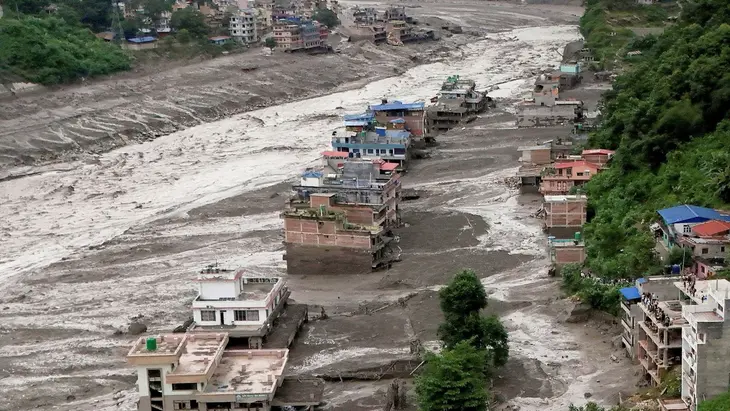

The death toll from the devastating flash floods in Nepal has risen to 1,295, while rescue teams achieved a remarkable breakthrough by pulling two workers alive from a hydropower tunnel after they remained trapped for nine days. The floods, triggered by an ice-rock avalanche near the Nepal-Tibet border on August 26, caused widespread destruction across northern and central parts of the country.
According to Nepal Police, 1,293 bodies have been recovered from eight affected districts, while two additional victims died in hospitals in Kathmandu. Search and rescue operations remain underway for thousands of people who are still reported missing. Authorities have so far rescued more than 13,000 people from the affected areas.
The two survivors, identified as 45-year-old Kabir Maharjan, a mechanical supervisor, and 30-year-old Sanjay Sah, a foreman, were rescued from the Trishuli 3A hydropower project. Both had been trapped inside the tunnel since the floods struck. Maharjan was taken to an Army hospital in Kathmandu and was reported to be in critical condition, while Sah was receiving treatment at a hospital in Nuwakot.
The successful rescue has raised hopes that other people trapped inside hydropower tunnels could still be found alive. Rescue teams continue to face difficult conditions caused by mud, debris and damaged infrastructure as they search several affected sites.
The disaster has also severely affected children and educational institutions. Hundreds of children remain unaccounted for in Rasuwa and Nuwakot, while schools and other public infrastructure have suffered extensive damage. Authorities are continuing efforts to verify missing-person figures and locate survivors.
India has also continued to support Nepal’s relief operations. Additional Indian Air Force relief flights carrying essential supplies, including medical materials and forensic kits, have reached Kathmandu to assist the ongoing rescue and recovery efforts.
Meanwhile, the Nepalese government has begun preparing longer-term recovery measures, including relief and financial support for businesses and people whose homes and livelihoods were destroyed. Rescue operations remain the immediate priority as teams continue searching for those still missing.