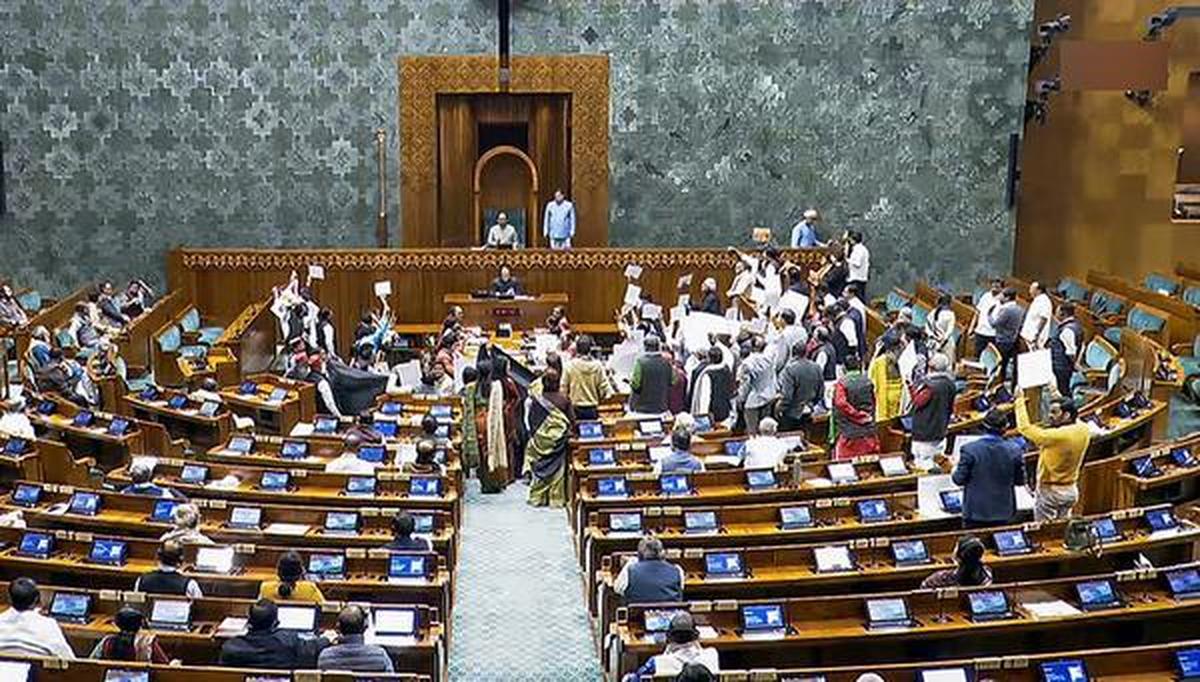

The Lok Sabha today began its general discussion on the Union Budget 2026–27, with proceedings starting at 11 a.m. and continuing into the afternoon. The debate focuses on the government’s financial roadmap, welfare legislation, and reform measures, while opposition parties are pressing their concerns on transparency and accountability.
During the session, Question Hour was followed by the tabling of official papers from ministries including Health, Law, External Affairs, Defence, and Shipping. Members across parties are debating the Union Budget 2026–27, presented by Finance Minister Nirmala Sitharaman on February 1, 2026.
Private Members’ Business scheduled from 3:30 p.m. onwards includes bills on constitutional amendments and the Representation of the People Act, along with welfare legislation for farmers, fishermen, students, senior citizens, women, and workers. Proposals on education, healthcare, environment, artificial intelligence, digital platforms, labour reforms, and social security are also expected to be discussed.
The Union Budget 2026–27 projects total expenditure at ₹53.47 lakh crore, an increase of 7.7% over the revised estimate of ₹49.6 lakh crore for 2025–26. Receipts excluding borrowings are estimated at ₹36.51 lakh crore, reflecting a 7.2% growth. Tax revenue is projected to grow by 8%. The fiscal deficit is pegged at 4.3% of GDP, while the revenue deficit remains at 1.5% of GDP, with nominal GDP growth assumed at 10%.
Opposition parties raised concerns over restrictions on Leader of Opposition Rahul Gandhi, who was barred from citing an unpublished memoir of former Army Chief General M.M. Naravane during a debate on the 2020 India-China standoff. Prime Minister Narendra Modi, in his address to the Motion of Thanks on the President’s speech, emphasized stability and reforms as the government’s priorities.
The deliberations highlight the government’s focus on accelerated growth with fiscal discipline, expanded welfare measures for farmers, workers, women, and students, and forward-looking reforms in technology and environmental protection.