
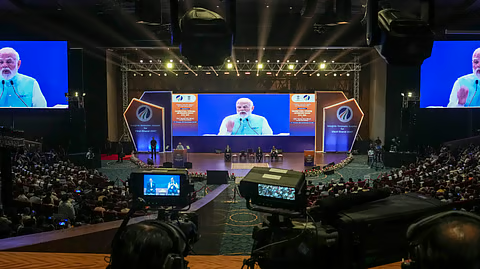

Prime Minister Narendra Modi on Monday said that India is encouraging high-risk, high-impact research and development (R&D) projects and promoting private investment in this sector to position the country as a global science and technology leader.
Inaugurating the first-ever Emerging Science, Technology and Innovation Conclave (ESTIC), an annual event bringing together policymakers, innovators, and international experts, the Prime Minister highlighted his government’s reforms aimed at building a modern innovation ecosystem in India.
During the event, Modi launched the ₹1 lakh crore Research, Development and Innovation Fund to boost private sector participation in R&D. “This major investment will benefit the public and open up new opportunities across sectors,” he said.
He explained that the government’s goal is to nurture a strong culture of research and innovation within the private sector. “For the first time, dedicated funds are being allocated to high-risk, high-impact projects to support groundbreaking work,” the Prime Minister stated.
Modi added that the government is working to enhance the ‘Ease of Doing Research’ by reforming financial regulations, simplifying procurement policies, and improving incentive structures. “We are ensuring that prototypes move quickly from the lab to the market,” he said.
Highlighting India’s progress in the last decade, Modi noted that the country’s R&D expenditure has doubled, reflecting its strong commitment to innovation. “The number of registered patents has grown 17 times, and India has now become the third-largest startup ecosystem in the world,” he said.
The Prime Minister also mentioned the creation of the Anusandhan Research Foundation, aimed at strengthening research and innovation across universities and generating new avenues for growth and collaboration.
Modi emphasized that inclusive innovation leads to shared progress, citing women’s increasing contributions in science and technology as a powerful example. “A decade ago, fewer than 100 patents were filed by women each year. Today, that number has exceeded 5,000 annually,” he shared.
He further noted that women now make up 43% of STEM (Science, Technology, Engineering, and Mathematics) students in India—much higher than the global average. “When science meets scale, innovation becomes inclusive, and technology drives transformation, great things happen,” Modi remarked.
Concluding his address, the Prime Minister said, “Over the past decade, India has shown that it is not merely a consumer of technology but a pioneer of transformation through technology.”