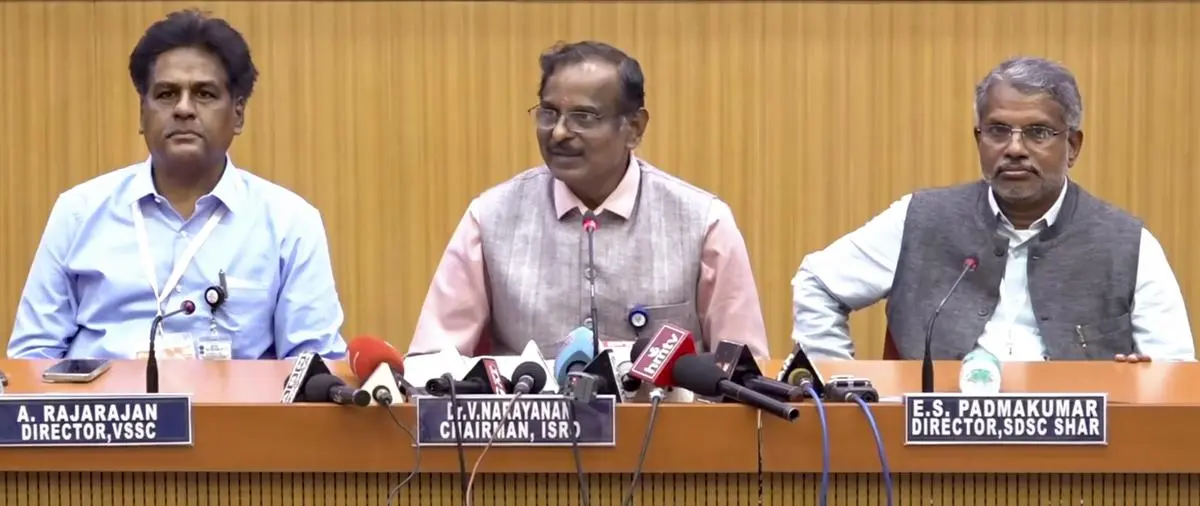

ISRO has set a target to launch seven missions, including its first uncrewed flight under the Gaganyaan programme, before the end of March 2026, Chairman V. Narayanan said on Sunday.
The Bengaluru-headquartered space agency plans to conduct three uncrewed missions prior to the crewed Gaganyaan flight, with the first uncrewed launch, the ‘G1 Mission’, expected by March 2026, he added.
“Our Gaganyaan programme is progressing well and is at an advanced stage. All hardware has arrived at Sriharikota, and integration is currently underway. We have planned three uncrewed missions, and the first, the ‘G1 Mission’, will be achieved before the end of the current financial year,” Narayanan said.
He made these remarks after the successful launch of the communication satellite CMS-03 aboard the LVM3-M05 rocket from Sriharikota.
Discussing upcoming mission plans, Narayanan, who is also Secretary of the Department of Space, confirmed that seven missions are scheduled before the end of March 2026. He said this initiative aligns with Prime Minister Narendra Modi’s vision of 50 rocket launches over the next five years.
“We have planned seven launches to take place before the end of this financial year, by March 2026,” he said.
Providing details of future missions, Narayanan said that after Sunday’s LVM3-M05 launch, ISRO will carry out another LVM3 rocket launch to place a commercial communication satellite for a client into orbit.
“After that, there are three more PSLV missions scheduled, including one for a NewSpace India Ltd (NSIL) customer satellite,” he added. NSIL is the commercial arm of ISRO.
Narayanan also noted that ISRO plans to launch a technology development mission, PSLV-N1, before the end of the current financial year. In addition, a GSLV-F17 mission is planned before March 2026.
Reflecting on the ambitious schedule, he said, “I know it is not an easy job. It is a tough job. But I am confident that we will accomplish these missions.”
He added, “Team ISRO is fully geared to meet the Prime Minister’s vision of launching 50 missions over the next five years.”