
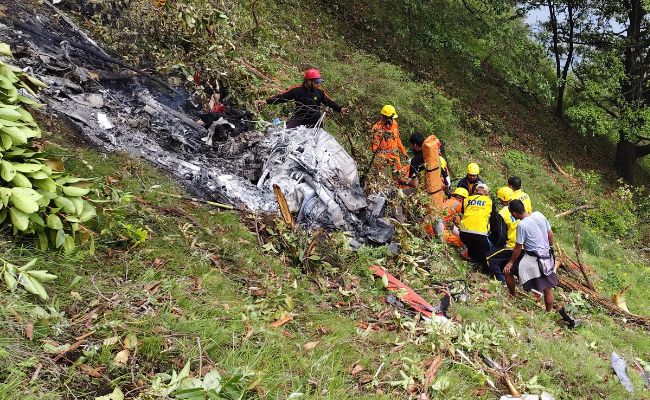

NEW DELHI, Nov 27: The last words from the pilot of the helicopter that crashed near the Kedarnath valley in June this year were, “cannot see anything, turning…,” according to the interim investigation report released by the Aircraft Accident Investigation Bureau (AAIB). The report notes that the valley exit was covered with clouds at the time of the accident, which claimed the lives of all seven people on board.
The 17-year-old Bell 407 helicopter (VT-BKA), operated by Aryan Aviation Pvt Ltd, had taken off from the Kedarnath helipad and was headed to Guptkashi when it crashed at 5.35 am on June 15. The aircraft was engulfed in flames upon impact near Gaurikund in Uttarakhand. The victims included the pilot, five passengers, and an infant.
According to the interim report, there was no technical abnormality observed when the helicopter departed from Kedarnath. The AAIB team, working alongside accredited representatives from the United States and Canada, continues to investigate the circumstances that led to the crash.
The US National Transportation Safety Board (NTSB) and Canada’s Transportation Safety Board (TSB) have both deputed experts to support the probe.
The AAIB examined CCTV footage positioned at the valley’s entry and exit points. The video shows dense clouds descending into the valley at the time of the crash. Two other helicopters that were flying behind VT-BKA managed to exit the valley by descending to a lower altitude to avoid the cloud cover.
As per established procedures, helicopters entering the Kedarnath valley must maintain 8,500 feet, while those exiting must fly at 9,000 feet. The report confirms that the pilot of VT-BKA was maintaining 9,000 feet as required, and no irregularities were seen during take-off or entry into the valley.
Further details from the AAIB show that Aryan Aviation’s operations team had spoken to the pilot of another helicopter, VT-TBC, earlier that morning. The pilot of VT-TBC informed them that VT-BKA’s pilot had reported cloud cover at the valley exit point. Moments later, he radioed, “cannot see anything, turning…”. No further communication or distress call was received thereafter.
The report highlights the absence of a dedicated meteorological facility in the Kedarnath valley. An Automated Weather Instrument (AWI) installed at the helipad provides live weather details but does not record data or offer cloud information. Weather updates are typically shared on a WhatsApp group of operators, but the report notes that the information was not shared before the first flight on the day of the accident.
The AAIB also confirmed that a technical advisor from Bell Helicopters visited Dehradun to examine the recovered parts of the aircraft. The majority of the damage was determined to be due to the severe impact with the terrain.
Following the fatal crash, the Directorate General of Civil Aviation (DGCA) issued revised safety guidelines in September for Char Dham operations, including stricter protocols for helicopter shuttle services to Kedarnath.